
Every great civilization begins with a question:
How do we keep order among people?
This question has defined the governance evolution of humanity – from Pharaohs ruling through divinity to citizens guiding nations through consent.
Across Typemock’s AI Blog and Aicracy.ai we explore how ancient systems of control are giving way to intelligent, transparent governance powered by collective reasoning.
Thousands of years ago, four great societies used different strategies — and the echoes of those choices still shape us today. Thousands of years ago, four great societies used different strategies and the echoes of those answers still shape us.
- China chose bureaucracy: order through merit and hierarchy, a system perfected in its imperial civil service that trained generations of scholar-administrators.
- Mesopotamia chose war : conquest as unity, fear as control, ruled by empires from Akkad to Babylon, where kings claimed power through victory and divine favor.
- India chose faith: cosmic law and moral duty as the framework of justice, the rhythm of life guided by Dharma and the promise of moral consequence.
- Egypt, the grandest of them all, chose divine kingship — the ruler as god, law, and destiny, sustaining the cosmic order of Ma’at through obedience and ceremony.
Each model worked for its time, yet each was built on the same foundation: control.
The Pharaoh controlled through divinity, the general through fear, the priest through virtue, and the citizen through consensus.
But something profound happened along this path, a moral evolution that transformed divine authority into democratic conscience.
🕎 Egypt and the Birth of Divine Order
In ancient Egypt, power flowed downward from heaven.
The Pharaoh was not merely a ruler; he was the living embodiment of cosmic order: Ma’at.
Justice, prosperity, and stability depended on the ruler’s perfection.
But when divinity is embodied, truth becomes inaccessible, whatever the Pharaoh says, is.
This model gave civilization structure, but also rigidity.
It unified through awe, but silenced through fear.
Humanity needed a new voice, one that could speak to power, not merely from it.
📜 The Prophets: Conscience Enters History
That voice arose among the slaves of Egypt.
The Hebrew prophets: Moses, Amos, Isaiah, Micah, Jeremiah did something unthinkable:
they confronted kings in the name of a higher moral law.
They declared that justice stood above the throne.
They measured nations not by their temples or armies, but by their compassion.
“What does the Lord require of you but to do justice, to love mercy, and to walk humbly?” — Micah 6:8
This was the moment divine kingship became divine accountability.
The power of God no longer sanctified rulers, it judged them.
From that moment, the covenant replaced the crown.
Judaism thus gave the world its first great idea of moral law above political law, a seed that would later grow into both Christianity and democracy.
🏛 Greece: Reason Replaces Revelation
The Greeks took the next leap.
They replaced sacred command with public reason.
In the polis, citizens argued, voted, and discovered that truth could emerge from dialogue rather than decree.
This was order through participation, democracy as a collective act of reasoning.
Greece transformed divine authority into civic deliberation, the first form of rational governance.
✝ Christianity: From Law to Conscience
Christianity united the Hebrew and the Greek worlds.
It turned moral law inward — into conscience.
Every person became a moral agent, a bearer of divine dignity.
The kingdom of God moved from the temple to the heart.
If Egypt made kings divine, Christianity made every person sacred.
From there arose the moral foundation of human equality — the bedrock of democracy.
🗳 Democracy: From Conscience to Consent
Modern democracy secularized this moral inheritance.
Instead of divine sanction, legitimacy now came from the people’s will.
Instead of prophets, we have journalists.
Instead of revelation, we have data.
Power is no longer sacred, it is contractual.
Yet democracy, too, faces its paradox:
as societies expand and voices multiply, consent alone no longer guarantees wisdom.
Majorities can be misled. Systems can be gamed.
We are once again seeking a higher order, not of control, but of coherence.
🤖 From Control to Coherence: The Next Stage in Human Governance
Aicracy is not the end of democracy, it is its evolution.
Where divine kingship ruled through revelation, and democracy rules through consensus,
Aicracy rules through understanding.
It combines:
- the moral oversight of the prophets,
- the reasoning of Greece,
- the dignity of Christianity, and
- the consent of democracy
and fuses them through collective intelligence.
Aicracy does not seek to replace human decision-making, it seeks to illuminate it.
It makes the invisible forces of bias, consequence, and complexity visible as prophecy once made moral truth visible.
It is, in essence, prophetic reason at scale.
🔄 How Aicracy Complements the Four Modern Systems
1. Bureaucratic States – From Process to Purpose
Bureaucracies excel in precision but often lose sight of meaning.
Aicracy adds feedback loops of truth, measuring not only whether procedures were followed, but whether they worked.
It keeps the order of China, but gives it the conscience of the prophets.
2. Militaristic States – From Fear to Foresight
Militaristic powers prize control and stability.
Aicracy reframes both as predictability and resilience.
It turns intelligence into transparency, making strength measurable without oppression, the sword guided by wisdom.
3. Faith-Based Societies – From Moral Ideals to Moral Evidence
Religious nations seek righteousness; Aicracy helps them measure it.
By aligning governance with ethical metrics: justice, mercy, equity
it transforms faith from belief into demonstrable moral action.
Faith remains the compass; Aicracy becomes the map.
4. Modern Democracies – From Opinion to Understanding
Democracies thrive on expression but struggle with noise.
Aicracy helps separate knowledge from confusion, wisdom from emotion.
It keeps freedom intact, but makes participation informed.
It is democracy with a mirror – not louder, but clearer.
🌍 The Fifth Paradigm: Wisdom as Governance
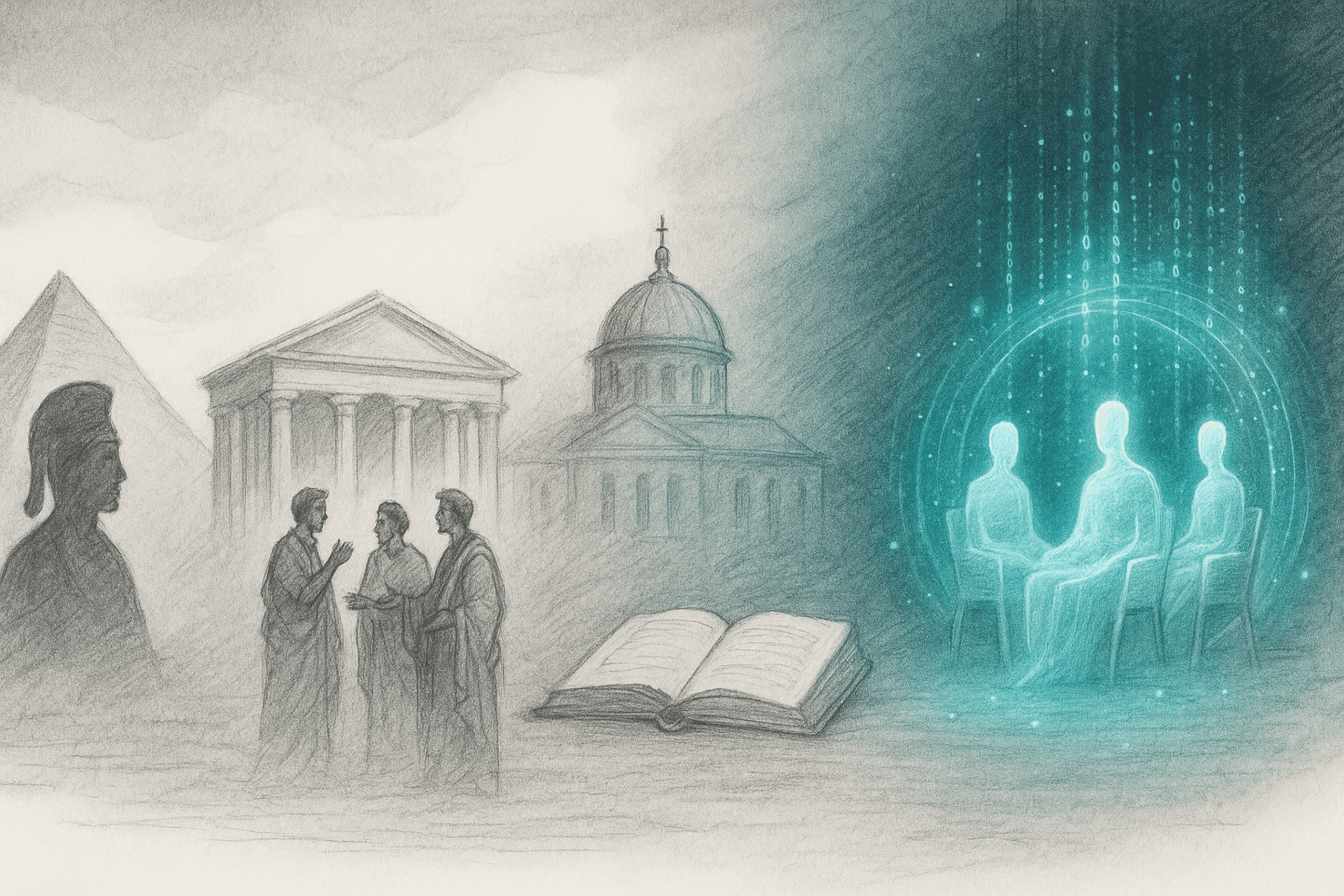
From Pharaohs to prophets, from philosophers to citizens, humanity’s story of power has always moved toward decentralized wisdom.
Aicracy is not a break from that story.
It is its next verse, a synthesis where faith, reason, morality, and technology converge to create governance that learns.
The Pharaoh ruled by divinity.
The prophets ruled by truth.
Democracy rules by will.
Aicracy rules by understanding.
Continue exploring the future of governance at Aicracy.ai.